The Quiet Language of Roses
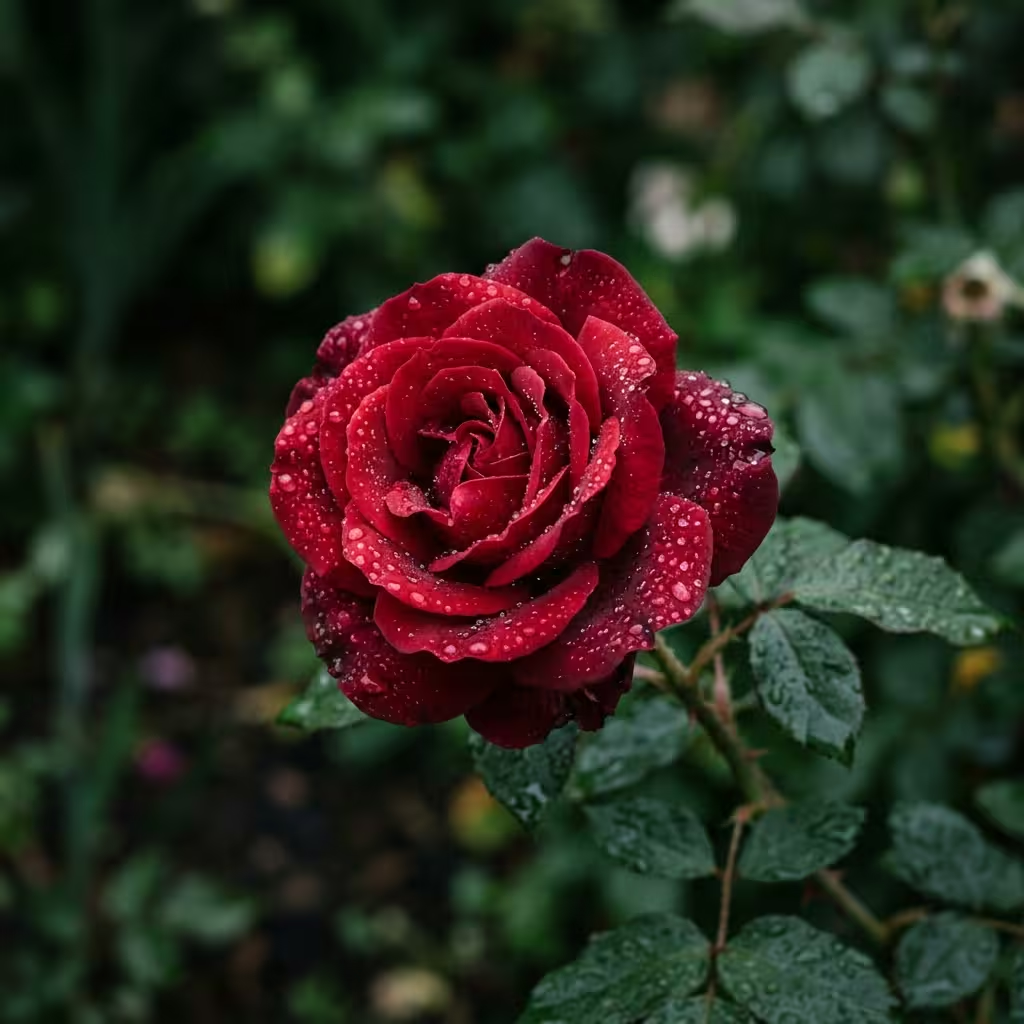
There is something disarmingly honest about a rose. It does not try to be beautiful — it simply is. And yet, beneath every petal lies a story older than civilization itself, a thread woven through myth, medicine, and meaning.
A Flower with Memory
The rose is one of the oldest flowers in cultivation. Fossil records suggest roses existed 35 million years ago, long before humans arrived to admire them. The earliest known cultivation began in China around 5,000 years ago, and since then, the rose has traveled across every continent, adapting and evolving, yet always retaining something unmistakably itself.
“What’s in a name? That which we call a rose by any other name would smell as sweet.”
— William Shakespeare, Romeo and Juliet
In ancient Rome, roses were synonymous with excess and luxury. Nero reportedly spent the equivalent of $150,000 on roses for a single banquet, draping them over ceilings and floating petals in wine. The Romans scattered them at weddings, funerals, and festivals alike — the rose was both celebration and elegy.
The Architecture of a Petal
What makes a rose so structurally compelling is its geometry. Each petal follows a logarithmic spiral, a pattern found throughout nature — in nautilus shells, hurricane formations, and spiral galaxies. This mathematical precision is what gives the rose its sense of inevitability, as though it could not have been shaped any other way.
A typical garden rose has around 40 petals, though some heritage varieties boast over 100. Each petal is covered in microscopic conical cells that scatter light, giving roses their characteristic velvet sheen. This is not decoration — it is communication. The texture and color of petals serve as landing signals for pollinators, a visual language as refined as any human design system.
Color and Meaning
The language of roses — floriography — was formalized in the Victorian era, when expressing emotion directly was considered improper. Each color carried a precise sentiment:
- Red — deep love and desire
- White — purity, innocence, and reverence
- Yellow — friendship, joy, and jealousy (depending on context)
- Pink — gratitude, admiration, and grace
- Black — farewell, mystery, and rebirth
This system was not arbitrary. It drew from centuries of cultural association, blending Persian poetry, Greek mythology, and Christian iconography into a shared visual vocabulary.
Growing Roses
If you have never grown a rose, you might assume they are delicate. They are not. Roses are, in fact, remarkably resilient. They thrive in challenging conditions and reward patience more than perfection.
The essential requirements are simple:
- Sunlight — at least six hours of direct sun daily
- Water — deep watering at the roots, not the leaves
- Pruning — strategic cuts that encourage outward growth
- Patience — the first season is for roots, the second for blooms
There is a meditative quality to tending roses. The act of pruning — removing what is dead to encourage what is living — is a practice that extends well beyond the garden.
The Rose in Modern Design
Contemporary designers often overlook the rose, dismissing it as cliché. This is a mistake. The rose’s formal properties — its radial symmetry, its gradient color transitions, its play of light on texture — offer a masterclass in organic design principles.
Consider the way a rose unfurls: each layer reveals itself gradually, creating a sense of depth and discovery. This principle — progressive disclosure — is one of the most important concepts in interface design. The best experiences, like the best flowers, do not show everything at once.
The rose does not hurry.
It opens when it opens.
And when it opens, it is always
exactly on time.
A Final Thought
We live in an age of speed, of optimization, of relentless forward motion. The rose offers a counter-argument. It suggests that some things are worth doing slowly, that beauty does not scale, and that the most profound communication often happens without words.
The next time you pass a rose — in a garden, in a shop window, in someone’s hand — pause for a moment. Notice the spiral. Notice the light. Notice how it asks for nothing and gives everything.
That is the quiet language of roses.